en es
RGJV Monitoring Recap – 2024

RGJV Monitoring Recap – 2024

The Rio Grande Joint Venture (RGJV) performs monitoring activities on private lands throughout its geography to understand how vegetation and/or bird abundance and diversity are changing in response to management actions designed to enhance and regenerate habitat. In 2024, we collected most monitoring data on properties enrolled in the South Texas Grassland Restoration Incentive Program (STX GRIP) and the West Texas Chihuahuan Desert Conservation Partnership (WTX CDCP). Additionally, other data were collected on riparian restoration areas along important creeks in the Trans Pecos, as well as in treated grasslands on private properties in Chihuahua, Mexico. RGJV Science Coordinator Rebekah Rylander hired, trained, and managed technicians with assistance from Jeff Bennett.

GEM & Bird Monitoring in South Texas

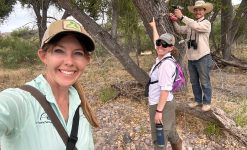
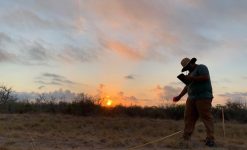
In May and June of 2024, three technicians assisted the RGJV with Grassland Effectiveness Monitoring (GEM) on 14 treatment sites across 11 properties in south Texas. (For more information on GEM, click here!) These technicians were students or recent graduates from various universities and brought a diversity of knowledge and experience to the field: Jessie Haudrich (Texas Tech University), Carolina Gutierrez (University of Arizona), and Karime Hernandez (Tarleton State University). Additionally, during the summer of 2024, one technician, Willy Hutcheson, performed point count surveys on 14 properties and 17 treatment sites in south Texas to assess bird abundance and diversity. Willy is a high school science teacher in Massachusetts but used to guide professional bird tours, including many in Texas.  His knowledge was invaluable.

Bird Monitoring in West Texas

In west Texas during the month of June, two technicians performed riparian avian point counts along two creeks in Presidio County where the RGJV has stationed autonomous recording units (ARUs). The RGJV wants to learn more about how the data that ARUs collect compares to human point counts when it comes to bird species detections and abundance. Both of these technicians are graduate students at Sul Ross State University in Alpine, Texas: David Tonnessen and Audrey Taulli.

Training

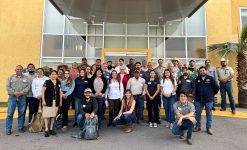
During late August of 2024, three partners from Mexico and two from west Texas were trained on GEM protocols for fall monitoring. Training occurred on a private ranch in Brewster County, and partners from Mexico assisted RGJV staff in translating protocols and survey forms into Spanish. Mexican partners who attended the training included Alicia Juárez and Sara Sáenz from Evaluación Integral y Restauración de Hábitat (EIRHA) and Rogelio Maciel from Pronatura Noreste. Alicia and her EIRHA team have surveyed almost 100 GEM points across 13 properties in Chihuahua, Mexico where grassland restoration projects have taken place. West Texas team Clif Ladd (with RainCrow Wildlife Consulting, trained this year) and Kelsey Wogan (Sul Ross State University, trained last year) have surveyed 6 treatment sites on 3 properties across the Trans Pecos.

Winter Bird Monitoring

Beginning in December, two additional technicians will begin winter bird monitoring for the RGJV in west Texas, Emily Blumentritt and Stephen Falick of Sul Ross State University. These winter bird surveys are crucial for understanding how management efforts to reduce shrub encroachment in grasslands are influencing bird populations that are dependent on the Chihuahuan Desert during the non-breeding portion of their annual cycle.

With all of the data collected across projects and in different geographies over the years, Rylander plans to begin statistical analyses in 2025. Results will hopefully assist biologists and conservation delivery specialists with recommendations on best management practices for restoring grasslands in south and west Texas, highlighting whether certain bird species are responding to treatments and increasing in abundance and also whether certain treatments should be limited to certain geographies across the Rio Grande Joint Venture.

Las Cienegas: Restoring Small Areas with Big Impact

Las Cienegas: Restoring Small Areas with Big Impact

Continuing work on one of the JV’s earliest projects (funded originally by TPWD and NFWF in 2019) Jeff Bennett, Price Rumbelow, the Dixon Water Foundation, and Borderlands Research Institute collaborated in 2024 to restore this important wetland using Pittman-Robertson funding.

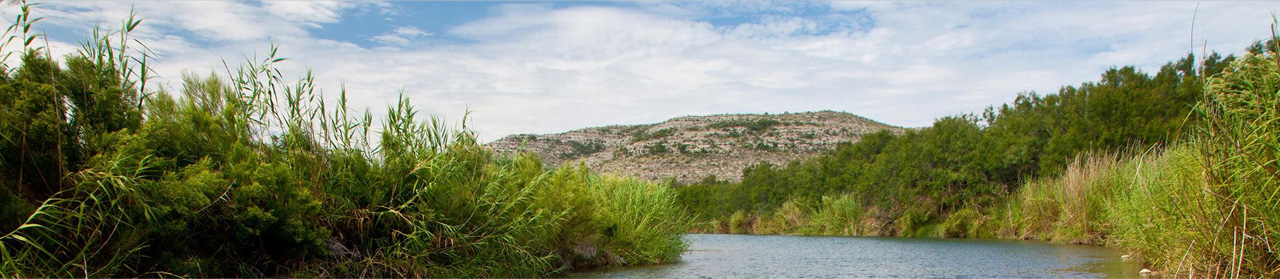
The Property is located on the southern flank of the Davis Mountains and is comprised of a unique combination of wetland and riparian habitat adjacent to a playa lake surrounded by mixed prairie and grassland habitats. Cienega Creek runs north-south through the property just east of the wetland and playa lake. Like most streams in the Big Bend, Cienega Creek is incised and therefore dryer than it was before the arrival of colonizers. A large, relic, gallery forest of cottonwoods and willows is supported by the underlying groundwater system.

The purpose of the activities within the project area is to increase water storage and residence time along Cienega Creek and to increase connectivity with the alluvial aquifer. This is being accomplished through the instillation of a variety of low-tech “filter dams,” including one rock dams, wicker or woven filter dams, and even engineered log jams. Our intent is to assess their effectiveness and demonstrate the effectiveness of the low-tech “filter dam” approach. Ecosystem services along Cienega Creek that will be improved include: filtering and storing water, recharging and discharging groundwater, and sediment storage–all while improving habitat for nesting and migrating birds. Small areas of restoration can have a large impact both upstream and downstream by creating a protected, nursery environments that will allow natural regeneration of riparian forest to occur.

IBWC/CILA sign Minute 331 establishing a Rio Grande Environment Work Group

IBWC/CILA sign Minute 331 establishing a Rio Grande Environment Work Group

The International Boundary and Water Commission US and Mexican sections signed Minute 331 (see ibwc.gov for details) on November 7, 2024, which among other things officially established a Rio Grande Environment Working Group. The formation of the RGEWG is a direct result of RGJV partners’ combined efforts to engage with the agency on recommendations for binational environmental projects that would enhance the environment of the Rio Grande basin. This is a huge step forward signifying that on-going discussions will take place around ways to improve the Rio Grande mainstem environment through project work on riparian habitat, enhancement in tributaries to the Rio Grande, public outreach and other collaborative effort.

Prior to the signing of the Minute, two meetings were held of the Rio Grande Environment Work Group on May 30, 2024 and on November 15, 2024. Representatives from IBWC, CILA, and the Comisión Nacional de Agua were present along with members of the conservation sector.

These meetings served to:

  • Draft a Workplan for 2024 that would form the basis for the 2025 Workplan and include a list of projects that partners would undertake under the auspices of the RGEWG;
  • Formally establish the members of the group (see list below);
  • Agree on a process by which projects would be proposed to IBWC/CILA;
  • Create a Project Information Form that would provide the basis for a peer vetting process within the RGEWG.

Participating agencies include:

Government Institutions in Mexico and the United States:

  • Mexican Section of the International Boundary and Water Commission
  • National Water Commission (Mexico)
  • Commission for Natural Protected Areas (Mexico)
  • U.S. Section of the International Boundary and Water Commission
  • National Park Service
  • Texas Commission on Environmental Quality
  • Texas Parks & Wildlife Department

Non-Governmental Conservation Organizations:

  • American Bird Conservancy
  • Audubon Texas
  • Rio Grande Joint Venture
  • World Wildlife Fund
  • Pronatura Noreste A. C.
  • The Nature Conservancy
  • Rio Grande International Studies Center
Fall Management Board Meeting in Mexico

Fall Management Board Meeting in Mexico

The Rio Grande Joint Venture Management Board and staff met in the lovely town of Santiago, Nuevo Leon, Mexico, in the Cumbres de Monterrey National Park on September 9 – 12, just as the town and the entire country was preparing for the upcoming 16 de septiembre holiday. Red, green and white bunting, Mexican flags, and festival announcements were everywhere in commemoration of México’s independence from Spain. Host organization Pronatura arranged for a field trip to the beautiful Cola de Caballo falls a short distance from Santiago, as well as the Cueva de los Murcielagos, where a large population of Mexican Free-tailed bats thrives. The group admired the streams of bats leaving the cave at sunset, along with views of an Aplomado falcon hovering near the cave mouth.

RGJV Management board and staff bid a fond farewell to long-time Board Chair Jeff Raasch, who is stepping down as Chair to take on new responsibilities as the American Bird Conservancy’s Southeast Regional Director. Jeff’s leadership helped uplift the Joint Venture community and was instrumental in standing up the Rio Grande Joint Venture in its early days at Texas Parks & Wildlife and then later as an ABC-administered Joint Venture, making it both bittersweet and appropriate that Jeff is now joining the ranks of ABC in a different leadership position. We will miss you Jeff, and wish you all the best in your new job!

Other board meeting highlights included: a discussion about how the Joint Venture can leverage more support for grassland and wetlands projects in México; the unveiling of a new Project Tracking Tool to showcase projects and partnerships throughout the geography; and the formation of a Policy Committee to plan and participate in the Association of Joint Venture Management Board annual visits to DC.

Featured presentations included:

  • Long-term Vegetation Monitoring Under Rotational and Set-Stock Grazing Management in the Native Prairies of Texas – Philip Boyd, Dixon Water Foundation
  • MOTUS work in NE Mexico – Salvador Narváez, Pronatura Noreste
  • CONANP projects in N. MX – José Davila, CONANP
  • Project work in Laguna de Santiaguillo and Laguna de Bustillos – Eduardo Carrera, Ducks Unlimited MX
  • Chihuahuan Desert inventory and monitoring program – Sally Hejl, National Park Service

Rosario Álvarez of Pronatura Noreste provided information about Cumbres de Monterrey, the park surrounding the Management Board meeting location, including its importance as the water supply for the city of Monterrey and efforts to implement sustainability programs, such as planting trees and improving distribution systems, in light of the water crisis of 2022 and 2023 when the reservoirs were at very low capacity.

Encuentro Ganadero del Desierto Chihuahuense Event

Encuentro Ganadero del Desierto Chihuahuense Event

The second Encuentro Ganadero del Desierto Chihuahuense event, led by our partners at Evaluación Integral y Restauración de Hábitat, was held Nov 14-15, 2024 in Chihuahua City, Mexico. The successful event was the result of the joint effort by Bird Conservation of the Rockies, Pronatura Noreste, Fondo Mexicano para la Conservación de la Naturaleza, Rancho Tres Papalotes, Rancho Terrenates, Tonkawa Consulting, and Facultad de Zootecnia y Ecología de la Universidad Autónoma de Chihuahua.

Photo By Jesús Franco

Now in its third year, this gathering of stakeholders, primarily from northern Mexico, is focused on bringing together private and communal landowners, government and non-governmental organizations, and academics to share and discuss natural resource sustainable use and management topics in the Chihuahuan Desert ecoregion.

This year’s agenda included topics related to the connection between drought and climate change, sustainable ranching on communal lands, grassland biodiversity, livestock marketing strategies, benefits of prescribed fire, as well as binational and trinational grassland bird conservation and investment strategies.

The indoor session was followed by a field trip to a private property where sustainable management/grassland bird habitat enhancements and partnerships between private landowners and governmental/nongovernmental organizations were highlighted.

Photo By Jesus Franco

Approximately 150 people attended, representing at least 10 different Mexico and US organizations including the Rio Grande Joint Venture.

Laguna de Santiaguillo

Laguna de Santiaguillo

The Rio Grande Joint Venture management board, staff, and guests enjoyed a field trip to Laguna de Santiaguillo during the August board meeting and learned a lot about this very important wetland in the state of Durango, MX. Both Ducks Unlimited Mexico (DUMAC) and Pronatura Noreste, (PNE) along with many other local partners, are working on conservation projects in the Laguna. Declared a RAMSAR site in 2012, the wetland comprises over 59,000 acres and 6 towns within its basin. It is considered a priority wetland by many agencies and organizations for its importance to migratory birds – particularly ducks, geese and wading birds that overwinter there – and for its value as a vital local water resource. However, the lagoon faces many challenges, as both DUMAC and PNE described.  A paper released in May 2023 also describes some of these challenges from local residents’ points of view, whose livelihoods are based largely on livestock, agriculture, and forestry within the basin.

Both DUMAC and PNE are working to improve sanitation and water quality in towns within the basin that are impacting the lake. DUMAC is installing biodigesters and other “eco-technologies” on individual properties, and PNE is installing larger scale biofilters designed to treat waste at a community level. DUMAC recently restored 15,500 acres of wetlands in a nearby town, and has launched an effort to partially restore flows to the southern end of Santiaguillo, which has largely dried up. Nevertheless, the southern portion of the lake has converted largely to grassland habitat that supports wintering species of birds and livestock grazing. DUMAC also provides teacher training programs and low impact cattle ranching workshops, conducts waterfowl surveys, and holds wetland and waterfowl workshops for professionals.

In addition to biofilters, PNE is

  • installing “keyline” projects to stimulate grass production
  • building filter dams made with rocks and discarded tires
  • building rock barriers for erosion control,
  • installing fencing to control grazing,
  • restoring a satellite wetland, and
  • conducting bird monitoring, environmental education in communities, and other research projects in collaboration with local universities and partners.


RGJV in the Process of Designing Project Tracking Tool

RGJV in the Process of Designing Project Tracking Tool

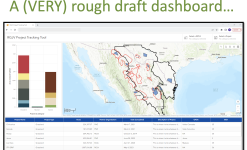
During the Rio Grande Joint Venture Board Meeting in Durango, Mexico, Science Coordinator Rebekah Rylander presented a rough draft of a project tracking tool that was created using Esri-based online applications. The goal of the project tracking tool is to provide RGJV partners a place to share general locations of where they are performing habitat management and restoration work, as well as the type of work being performed, project completion dates, and if other partners were involved. The tool, in its infancy, contains an interactive map, where users can zoom in and select individual projects, pulling up a dashboard that provides a table of information about the specific project. (However, the tool will not publicly display shapefiles and will limit zoom to protect private information.) Users can also select projects by using a drop-down menu that lists projects by name, or by using a different drop-down menu that lists grassland priority conservation areas (GPCAs).

The next steps will be to add an option in the project tracking tool dashboard that will allow users to see photos of the project site and/or partners working together on management activities. Additionally, the dashboard will eventually incorporate an interactive chart or graph that will display the number of acres that have been restored within certain GPCAs, the management practices used, and the level of habitat restoration goals achieved within these focal areas.

The overarching goal of the project tracking tool is to give partners (and funders, in the future) an idea of the progress being made, and the work still left to be done, in restoring declining grasslands in the Chihuahuan Desert. The tool may also help organizations and individuals connect with appropriate conservation partners in the region. A committee composed of RGJV staff, board members, and partner organization staff has been formed to further develop the project tracking tool, with the objective of presenting an updated version at the next management board meeting in February 2024.

PIF Public Awareness Award

PIF Public Awareness Award

A BRIEF REPORT BY JESÚS FRANCO ON PIF PUBLIC AWARENESS AWARD FOR MUSEO DE LAS AVES DE MÉXICO, JUNE 3, 2023:

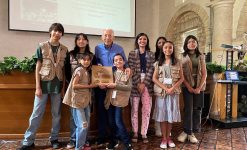
On June 3, 2023, Jesús Franco of the Rio Grande Joint Venture and American Bird Conservancy presented, on behalf of Partners In Flight (PIF), the 2022 Partners In Flight Public Awareness Award to the Museo de las Aves de Mexico (MUSAVE) in the City of Saltillo.

The PIF Award category for Public Awareness honors an individual or group that contributes significantly to increasing the public’s awareness and appreciation for birds, their habitats, or the need for conservation.

Museo de Las Aves de México (Museum of Birds of Mexico) was selected to receive a Group PIF Public Awareness Award for its successful environmental education program for the conservation of Mexico’s national avifauna. Founded in 1993, the Museum’s main objective is “To Know in order to Value and Preserve” (Conocer para Valorar y Conservar) because nobody loves or values what they do not know! Its dioramas and exhibitions, which portray the natural history of Mexican avifauna in the country’s major ecosystems, are of incalculable value for Mexican society because no other museum exhibits the incredible wealth of bird species present in Mexico. Its collections have benefited many other fields of science and humanities, used by authors of field guides, artists, law enforcement agencies, planners, and ecologists. As an institution outside the federal government, MUSAVE is also involved in conservation of biodiversity through providing awareness and protection of sites of high biological importance, including the Museum’s nature reserves, La India and El Taray, which protect endangered endemics.

The award ceremony started with welcoming words from the museum’s director and science staff and a video detailing the history of the museum as well as its impact. Jesús next gave a brief presentation about PIF, including its conservation and education work in the Americas and information on the history of the PIF awards. All 2022 award winners from the US and Latin America were acknowledged during the presentation. The ceremony then culminated with the presentation of the 2022 Public Awareness Award to MUSAVE. The pleasantly surprised and moved Museum founder Aldegundo Garza de León received the award only to immediately turn around and recognize the Museum staff and board of directors for this award. All were beaming with pride and expressed their gratitude to PIF for this award.

The ceremony was followed by a tour of the museum’s exhibition areas guided by an army of very knowledgeable youth volunteer guides. Mr. Garza de León himself also accompanied the tour and  delighted the audience with amazing stories of the adventures he encountered through his many years in the field collecting samples of the unique avifauna of the country in some of the most remote areas of Mexico.

RGJV’s 2023 Monitoring Program Expands to West Texas, Second Year in South Texas

RGJV’s 2023 Monitoring Program Expands to West Texas, Second Year in South Texas

During the spring and summer of 2023, the Rio Grande Joint Venture’s science coordinator Rebekah Rylander initiated the joint venture’s first season of monitoring in west Texas and second season of monitoring in south Texas. The 7 treatment sites surveyed in west Texas were on private properties involved with the Chihuahuan Desert Conservation Partnership (CDCP), and the 14 treatment sites that were surveyed throughout south Texas were on private properties enrolled in the Grasslands Restoration Incentive Program (GRIP). Both programs (led by Jeff Bennett in west Texas and Jesus Franco in south Texas) restore and improve native grassland habitats throughout the region with the goal to increase breeding and wintering grassland bird populations that are currently in decline.

To collect sufficient data on restoration projects, the RGJV used the Grassland Effectiveness Monitoring (GEM) protocol, a detailed survey methodology adapted from the Bureau of Land Management’s Assessment, Inventory, and Monitoring (AIMs) survey and NRCS’s Natural Resources Inventory (NRI). For more information on vegetation survey methodologies that the RGJV uses, visit the GEM Story Map. For avian monitoring on grassland sites in south Texas, the RGJV used a grid-style point count method similar to the Bird Conservancy of the Rockies (BCR) winter bird monitoring protocol.

Rebekah Rylander trained and managed three crews across the geography to collect data using the GEM protocol. One crew covered Hudspeth and Culberson Counties in west Texas (Brandi Griffin and Cole Kempton of The Barn Group Land Trust); another crew covered sites in Brewster, Jeff Davis, and Presidio Counties in west Texas (Kelsey Wogan, a graduate student from Sul Ross State University, Jeff Bennett of the RGJV, and Rebekah Rylander, the author); and lastly a crew surveyed across all south Texas sites (Micah Rainey, a student in the School of Veterinary Medicine at Texas Tech University, and Brandi Griffin of The Barn Group). Additionally in south Texas, Sonia Duran, a graduate student from the University of Texas Rio Grande Valley, received training from Rebekah Rylander in how to conduct point counts for priority grassland bird species.

Streambed, Riparian, and Bird Song Monitoring

In addition to grassland monitoring efforts, the RGJV also began its first season (summer of 2023) conducting official streambed and riparian monitoring surveys on 4 treatment sites in west Texas with efforts led by Jeff Bennett. Data was collected on streambed cross-sections, stream flow, canopy cover, vegetative response, and other metrics to assess how the installation of brush and rock dams in selected locations is influencing the health of stream systems. Monitoring and survey efforts have been executed by Jeff Bennett and Kelsey Wogan.

Finally, the RGJV, with assistance from the Dixon Water Foundation’s Philip Boyd and Sul Ross State University’s Dr. Maureen Frank, installed 8 autonomous recording units (ARUs) along several selected properties in west Texas, including Alamito Creek Preserve. ARUs are designed to passively record bird vocalizations to assess if priority avian species are using the riparian corridors where the RGJV has focused restoration efforts. They can also detect if birds are likely breeding in an area (if vocalizations persist throughout the summer) or if they are likely using the riparian habitat as migratory corridors (vocalizations only detected during the spring and fall).

All in all, the RGJV is pleased with the progression of the 2023 monitoring season and is excited to potentially expand monitoring efforts further into the Chihuahuan desert grasslands as Mexican partners gain interest. With data sets collected using the same methodologies, we hope to better understand how restoration efforts are influencing vegetation and bird response across a larger geography.

Employment Opportunity: Rio Grande Joint Venture (RGJV) Conservation Delivery Specialist

Employment Opportunity: Rio Grande Joint Venture (RGJV) Conservation Delivery Specialist

Position Summary:

Title:  Rio Grande Joint Venture (RGJV) Conservation Delivery Specialist
Supervisor:   Rio Grande Joint Venture Habitat Restoration Hydrologist
Job Type: Full-Time
Salary: $65,000; Based on experience
Location: Alpine, Texas

Apply for this position here. 

Introduction:

The mission of American Bird Conservancy (ABC) is to conserve birds and their habitats – the places birds need to thrive – across the Americas. We are a growing group of 125+ dedicated staff, located across the United States and with a network of partners from Canada to Chile. Each year, we grow in budget and staff, and we deliver more results aimed at preventing bird species extinctions and reversing declines that are reducing populations of nearly all bird groups. Our work is guided by our principles, which include a commitment to Justice, Equity, Diversity, and Inclusion (JEDI).

This position will foster the mutual conservation objectives of the RGJV, US Fish and Wildlife Service, Texas Parks and Wildlife and other partners (see RGJV board) by enhancing wildlife habitat in streams and uplands of the Chihuahuan Desert. This position contributes to the goals and objectives of the Texas Conservation Action Plan, the National Fish Conservation Area in the Chihuahuan Desert, and national and international bird conservation plans by working closely with RGJV, American Bird Conservancy (ABC), and Texas Parks and Wildlife Department (TPWD) staff and other partner organizations to provide technical and financial assistance related to habitat enhancement and restoration.

Major Duties:

  • Establish, improve, and maintain grassland habitats and riparian zones;
  • Conduct outreach to landowners and partners and advise/recommend/support restoration and/or habitat management and improvement projects;
  • Conduct data collection, reduction and reporting of stream characterization or monitoring data;
  • Implement a low-tech, process-based stream restoration plan on cooperating private land as well as public lands that includes but is not limited to siting and laying out in-stream structures, and supervising the construction of in-stream structures;
  • Operate appropriate heavy equipment in support of the implementation of stream restoration or wildlife habitat management plans;
  • Lend technical assistance to partners with respect to stream restoration techniques and construction upon request;
  • Coordinate and aid in preparation of appropriate CAD drawings and permits for stream restoration and habitat management activities;
  • Candidates will often work outdoors, in relatively difficult weather conditions
    • Job will require wading in streams, walking on uneven terrain, manual labor, working in close proximity of large heavy equipment, odd hours, and travel/time away from home.
      • Required to travel up to 30% with possible overnight stays.
    • Driving to sites may require maneuvering over steep, uneven terrain along rivers and streams;
  • Manual labor often required, including lifting supplies and materials up to 40 lbs.;
  • Working with and around light and heavy equipment or machinery;
    • Experience or ability to operate excavators, track trucks, dump trucks, skid steers, and farm tractors;
    • Experience or ability to operate power hand tools such as gasoline powered chain saws, drills, chainsaws, cutoff saws, etc.;
  • May be required to operate a State vehicle;


Qualifications:

  • A fundamental knowledge of water, environmental, agriculture and/or natural resource science.
  • Working knowledge of AutoCAD, GIS, and/or RiverMorph;
  • Excellent computer skills and ability to use databases and specialized software;
  • Ability to communicate and interact effectively and professionally with private landowners, land managers, advisory boards, universities, consultants, governmental and nongovernmental organizations, as well as the general public;
  • Knowledge of grassland and/or riparian ecology and research issues;
  • Ability to design and write habitat management plans;
  • Skill in reviewing, analyzing, and presenting technical data and documents;
  • Ability to maintain accurate records and prepare written correspondence;
  • Ability to provide site investigations, sampling and analysis to determine restoration plans;
  • Ability to work independently with little or no supervision;
  • Master’s degree, preferably in hydrology, environmental engineering, geology, environmental science, range science, or closely related field in natural resources management, or bachelor’s degree with equivalent experience;
  • Some experience with on-the-ground conservation planning and implementation preferred;
  • Experience in one or more of the following areas: hydrology, environmental engineering, ecosystem restoration or environmental planning in private, government, or academic arenas;
  • Desire to improve habitat conditions and overall health and wellbeing of our environment;
  • Applicant must possess a valid State driver’s license. CDL a plus.
  • Background screening required
  • Position open to US Citizens or Permanent Residents


Benefits:

  • Benefits include medical, dental, flexible spending accounts, and supplemental health insurance policies; including vision.
  • Paid vacation days, holidays (10+), sick leave, retirement savings with employer match, life insurance, parental leave, and Verizon cell service discount.


At American Bird Conservancy, we believe that a diversity of backgrounds, perspectives, and skills makes us more effective. We are committed to creating a respectful and inclusive work environment for all of our employees.

As an equal opportunity employer, ABC is committed to ensuring that employees and applicants for employment have equal opportunities regardless of race, color, national origin, ancestry, sex, age, religion, physical or mental disability, medical condition, veteran status, marital status, pregnancy, sexual orientation, gender identity, gender expression, or any other factor unrelated to the requirements of the position.